Channel Manager vs Booking Engine: What Independent Hotels Need First

Booking engines and channel managers are complementary: booking engines capture direct revenue and guest data while channel managers synchronize distribution to prevent overbookings. Most independent hotels benefit from running both. If you can only invest in one right now, start with a strong booking engine, since it protects your margin on every booking you already have the demand for.
TL;DR:
- Room and rate mapping errors can break synchronization without clear alerts, so test a booking on every connected channel after integration changes.
- The Expedia Group study found most connected properties trusted rate and availability updates to sync within 15 minutes, while unconnected properties faced greater overbooking risk.
- If your website attracts visitors but converts few, improve checkout before adding distribution tools; heavy OTA reliance and limited staff strengthen the case for channel management.
- Assign one staff member to review failed or delayed syncs weekly, check rate parity on top selling OTAs, and reconcile bookings with payments monthly.
- Hotelia currently combines a direct booking engine with a full property management system, but channel management and OTA synchronization are not yet available.
Table of Contents
- 1. What a booking engine actually does for your hotel
- 2. What a channel manager does for distribution
- 3. Key differences: who controls what and which number each one protects
- 4. How booking engines and channel managers work together
- 5. Deciding if you need both systems right now
- 6. Operational checklist for weekly and monthly reviews
- 7. Hotelia perspective: how an integrated booking platform supports independent hotels
- 8. Why the common advice on this topic misses the point
- 9. Keep more of every direct booking you already earn
- FAQ
- Sources
1. What a booking engine actually does for your hotel
A booking engine is the system that sits on your own website and lets a guest check dates, see a rate, and pay, all without leaving your site. Its job is to turn a website visitor into a paying guest at full margin, with no OTA commission taken off the top.
A booking engine worth running should give you:
- Real-time availability and secure payment capture, usually through Stripe or a similar payment processor.
- A mobile-optimized, branded checkout that matches your website instead of redirecting guests somewhere else.
- Support for packages and add-ons presented during booking, not as an afterthought.
- Guest data capture tied to analytics, so you build your own marketing list instead of renting it from a third party.
The State of Distribution Report 2026 found that website booking engines sit near the top of hotel tech adoption, used by a large majority of properties surveyed. Having one is standard. Having one that actually converts is where the advantage lives.
2. What a channel manager does for distribution
A channel manager is the system that keeps your rates, availability, and restrictions consistent across every OTA you sell on, along with GDS connections if you use them. Instead of logging into Expedia, Booking.com, and others one at a time, you update once and the channel manager pushes that update everywhere.
What a channel manager needs to handle well:
- Two-way sync of availability, rates, and booking restrictions across every connected OTA and GDS.
- Accurate rate-plan and room-type mapping, since a mismatch is what causes a guest to book a room that does not exist.
- Fast change propagation, so a sold-out date actually closes everywhere within minutes, not hours.
- Clear error and alert handling when a sync fails, instead of silence until a guest shows up to a room you already sold twice.
Done well, a channel manager replaces a stack of manual updates with one source of truth, which is also what protects your standing with OTA partners who penalize properties for inaccurate availability. The State of Distribution Report 2026 puts channel manager adoption at over three-quarters of properties, meaning it is now closer to a baseline expectation than a nice-to-have.
3. Key differences: who controls what and which number each one protects
The two systems protect different numbers, which is why comparing them head-to-head misses the point. A booking engine protects your margin on the booking you already won. A channel manager protects your inventory accuracy across every channel you did not win directly.
- Booking engine: you control the guest relationship, own the guest data, and keep 100% of the booking value.
- Channel manager: you control distribution reach, but each OTA booking carries a commission and the guest data mostly stays with the OTA.
- Sync latency matters more than it sounds: slower updates mean a longer window where a room can get double-sold.
- Mapping errors, not just slow syncs, are a common root cause of overbookings when room types or rate plans do not line up across platforms.
Full system connectivity changes outcomes measurably. An Expedia Group study found that the majority of fully connected properties report confidence that rate and availability updates sync within 15 minutes, while unconnected properties are more likely to experience overbookings. Speed of sync is not a technical detail, it is the difference between a clean distribution strategy and a guest standing at your front desk with no room.
4. How booking engines and channel managers work together
In a typical independent hotel stack, the flow runs from your booking engine into your property management system, and from your PMS out to your channel manager, which then pushes updates to every connected OTA.
A reservation made on any channel should update availability everywhere else within that same loop.
- A guest books directly through your website, and the booking engine records it in your PMS in real time.
- Your PMS updates the live room count, which the channel manager reads and pushes out to connected OTAs.
- An OTA booking comes in, and the same loop runs in reverse, closing that inventory on your direct site and other channels.
- Rate changes you make in one place propagate the same way, so a rate parity issue does not quietly appear on one channel while looking fine on another.
The most common failure point is mapping: a room type or rate plan that is labeled slightly differently in two systems can break the sync without triggering an obvious error. AHLA and HTNG workgroups have pushed for clearer messaging standards for exactly this reason, to reduce the guesswork in how systems talk to each other.
Pro Tip: Run a test booking through every connected channel after any integration change, then confirm it shows up correctly in your PMS and closes availability everywhere else.
5. Deciding if you need both systems right now
The right starting point depends on your property, not on what the industry average looks like. Before you invest in a second system, look honestly at a few numbers.
- Room count and team bandwidth: a small team managing updates across several OTAs manually is the clearest sign you need a channel manager now.
- Percentage of revenue from OTAs versus direct traffic: heavy OTA dependence raises the cost of any sync error.
- Direct-traffic conversion: if your website gets visitors but few bookings, a stronger booking engine is likely to move revenue faster than better distribution will.
- Vendor questions worth asking either way: how does integration work with your current PMS, what is the support response time, how are payments processed, and what uptime commitment do they offer.
If you are choosing where to start, a booking engine tends to deliver the clearest margin benefit for small teams, since every direct booking it wins comes with no OTA commission attached.
6. Operational checklist for weekly and monthly reviews
Treat your distribution stack like something that needs a regular check, not something you set up once and forget.
- Weekly, check your sync-status dashboard for any failed or delayed updates across connected channels.
- Weekly, review recent sync errors and spot-check rate parity on your two or three highest-volume OTAs.
- Monthly, review your direct booking conversion funnel to see where visitors are dropping off before checkout.
- Monthly, reconcile payments against bookings to catch any mismatch early.
- Monthly, review inventory buffer settings around high-demand dates, since those are where sync delays cause the most damage.
Assign one person on your team to own this review and set up automated alerts for sync failures so nobody finds out about a problem from a guest at the front desk.
Pro Tip: Keep a simple log of every sync error you catch, even small ones. A pattern across a few weeks usually points to a mapping issue worth fixing once instead of a glitch worth ignoring.
7. Hotelia perspective: how an integrated booking platform supports independent hotels
We built Hotelia as an all-in-one platform that combines a direct booking engine with a full property management system, so the booking-engine side of this stack is not something you have to bolt together from separate tools. Reservations, front desk check-in and check-out, and live room status all run from the same place.
For small teams, the operational details matter as much as the big picture: task automation and housekeeping workflows cut down on manual tracking, upsell tools add flat-priced options at checkout, and payouts settle directly through secure payment processing. Channel manager and OTA distribution sync are not part of the platform yet. They are coming soon, and we will describe them as live only once they are.
8. Why the common advice on this topic misses the point
Most guidance treats choosing between a booking engine and a channel manager like picking a side, when the real decision independent hotels face is sequencing, not exclusivity. The conventional advice tends to assume every property has equal OTA dependence and equal team bandwidth, which is rarely true for a 20-room inn compared to a 60-room property with three front desk shifts.
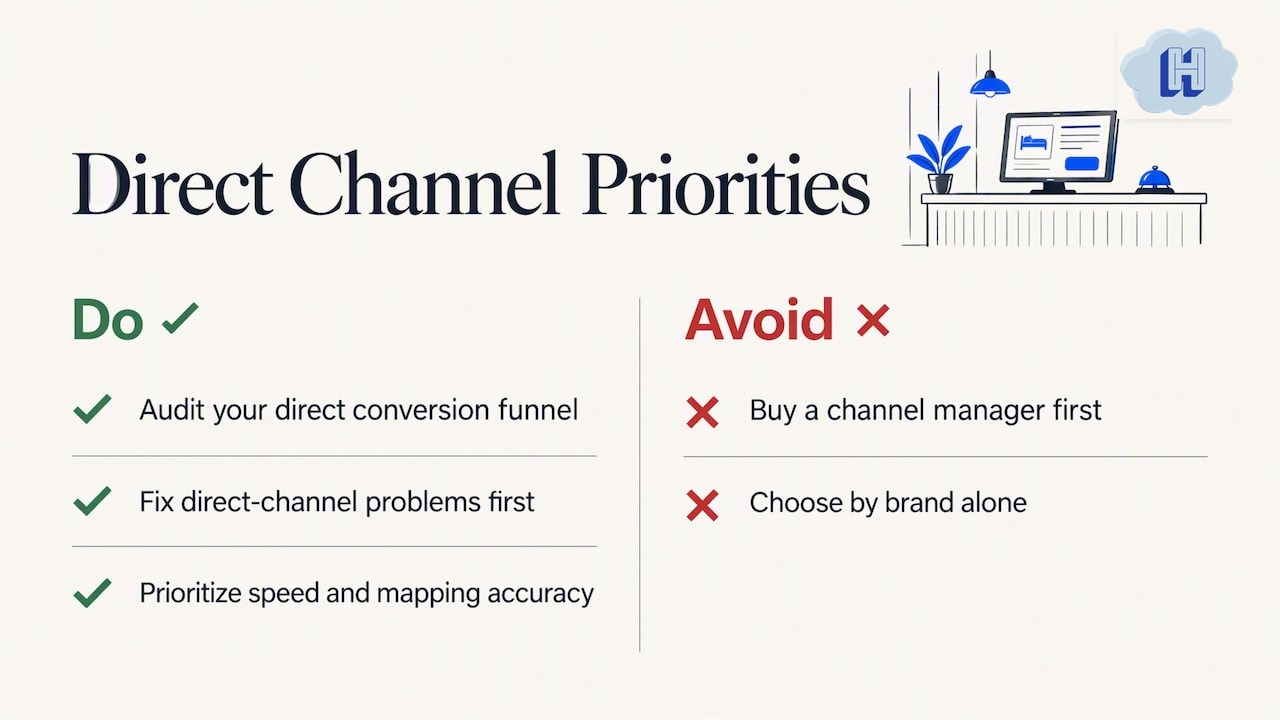
What the research actually supports is narrower: connectivity speed and mapping accuracy matter more than which brand of channel manager you pick, and a booking engine with a weak checkout wastes the direct demand you already have before distribution even enters the picture. The overrated move is buying a channel manager first because it sounds more sophisticated. The underrated move is auditing your own direct conversion funnel before spending anywhere else.
If you take one thing from this, prioritize fixing what is already broken in your direct channel before you add complexity to your distribution. A clean, well-converting booking engine is the foundation everything else sits on.
Hotelia Team
9. Keep more of every direct booking you already earn
We built a platform around one simple idea: the booking you win on your own website should not cost you a commission. Our platform combines a direct booking engine, a full property management system, and flat-priced upsells, all live on your own site the same day you set it up, no developer required.

If you are weighing where to put your time this quarter, start with the system that protects your margin on demand you already have. You can try Hotelia free for 30 days or look at pricing for Hotelia Pro to see what fits your property.
FAQ
What is the best channel management software for hotels?
There is no single best option. It depends on which OTAs you sell on, how your PMS connects to it, and how quickly it propagates rate and availability changes, which the Expedia Group study shows is a major factor in overbooking risk.
What is the monthly fee for a channel manager?
Channel manager pricing varies by vendor and by how many OTAs and rooms you connect, so there is no single published rate across the industry. Ask any vendor for a quote based on your property size and the channels you need connected.
Is Booking.com a channel manager?
No. Booking.com is an OTA, a channel you sell through, while a channel manager is the software that connects your property to Booking.com and other OTAs at once to keep availability and rates in sync.
Which channel manager is best for Airbnb?
Channel manager compatibility with Airbnb depends on the specific vendor’s connections, so check directly with any provider you are evaluating to confirm Airbnb sync is supported before committing.
Does Hotelia include a channel manager?
Not yet. Hotelia currently offers a commission-free direct booking engine and full property management system, with channel manager and OTA sync capabilities coming soon.
Sources
- Expedia study finds full connectivity drives hotel performance
- The State of Distribution Report 2026
- HTNG / AHLA workgroups and resources
Recommended
Thanks for reading The Hotelia Dispatch!
Subscribe to get new posts delivered to your inbox.
See Hotelia in Action
Hotelia is a modern booking engine and property management platform built specifically for independent hotels. Keep more of what you earn with 0% commission on direct bookings.