
Stop Chargebacks: Deposit Policy Playbook for Independent Hotels

A hotel deposit is money you collect from a guest to guarantee a booking or cover potential charges, and it’s different from a pre-authorization, which is just a hold that reserves funds without moving them. The best practice is simple: publish a clear deposit policy before the guest books, then use the right tool for the job. Collect an advance payment at booking to guarantee revenue, and place a pre-authorization at check-in to cover incidentals.
TL;DR:
- Hotels should match deposit types to risk, using a real charge to guarantee revenue and a pre-authorization for incidentals to minimize guest confusion.
- Incidental holds should be released within 48 to 120 hours after checkout to avoid guest frustration and reconcile cash flow efficiently.
- Clear, upfront communication of deposit policies, covering amounts, timing, refunds, and dispute procedures, significantly reduces guest misunderstandings and disputes.
- Automating deposit management through integrated PMS and payment platforms minimizes errors, speeds refunds, and encourages direct bookings without commission fees.
- Strict deposit rules balance revenue protection with reducing booking barriers, applying more rigid terms during high-risk periods and easing them at other times for better guest relations.
Table of Contents
- What is a hotel deposit and how does it differ from a pre-authorization?
- Why hotels charge deposits (business reasons and revenue protection)
- Types of hotel deposits and how each works in practice
- How much to charge and typical hold durations
- When and how to collect deposits: timing, channels, and payment methods
- How to write a clear deposit policy and communicate it to guests
- Managing disputes, refunds, and chargebacks
- Operational best practices: a checklist for front desk and revenue teams
- Author perspective: operational tradeoffs and where to be flexible
- How a direct-booking platform and PMS can simplify deposit management
- Sources
- FAQ
What is a hotel deposit and how does it differ from a pre-authorization?
A deposit is an actual charge. The money moves from the guest’s card into your account, and it shows up as a real transaction that needs to be refunded if the guest cancels or checks out with a clean room. A pre-authorization is different: it’s a hold that reserves funds on the guest’s card without ever touching your account. Nothing settles unless you convert the hold into a real charge.
That difference matters for your books and for the guest’s experience. A hold can disappear from a guest’s available balance for days, which can confuse them if they check their bank app. A deposit sits in your account and needs a formal refund process if you return it.
Here’s how to decide which one to use:
- Use a charge when you need guaranteed revenue, such as for a non-refundable rate or a group booking.
- Use a pre-authorization when you’re covering possible incidentals, like minibar charges or damage, and expect to release the hold if nothing happens.
Why hotels charge deposits (business reasons and revenue protection)
Deposits exist because guests cancel, no-show, and sometimes damage rooms, and a property with thin margins can’t absorb those losses quietly. A deposit converts a maybe into a commitment. Once a guest has money on the line, they’re far less likely to treat a reservation as disposable.
Deposits also change behavior before the stay even starts. A guest who pays a deposit at booking tends to follow through, and a guest who knows an incidental hold is coming tends to treat the room with more care. Industry guidance on preventing no-shows recommends combining clear cancellation windows with deposits and pre-arrival communication, which together do more to protect occupancy than any single tactic alone.
There’s a fraud angle too. A card that fails at the deposit stage is a warning sign worth catching before check-in, not after.
- Guaranteed revenue: an advance deposit locks in payment even if the guest never shows.
- Cancellation deterrence: a non-refundable amount makes a guest think twice before backing out.
- Damage and incidental coverage: a hold or deposit gives you a fast way to recover costs without chasing a guest after checkout.
Types of hotel deposits and how each works in practice
Not every deposit does the same job, and mixing them up is where a lot of front desks get into trouble. Here’s how the common types break down:
- Advance or non-refundable deposit. Charged at booking, usually tied to a discounted rate. Your booking engine should show the cancellation terms clearly before the guest confirms, since a surprise non-refundable charge is one of the fastest ways to generate a chargeback.
- Security or damage deposit. Either a real charge you refund after checkout or a hold you release. If you charge it, build an inspection step into checkout so refunds go out the same day, not a week later.
- Incidental pre-authorization. A short-term hold placed at check-in to cover minibar use, room service, or minor damage. It should be released promptly at checkout if nothing is charged against it.
- Full prepayment. Common for packages, extended stays, or group blocks where the whole balance is collected upfront rather than staged.
- Special-case deposits. Pet fees, early check-in guarantees, or late checkout holds. These are usually smaller, flat amounts tied to a specific service rather than the room itself.
A boutique property with a small number of rooms and a resort with a golf course rarely need the same deposit structure, so match the type to the actual risk you’re covering rather than copying a template wholesale.
How much to charge and typical hold durations
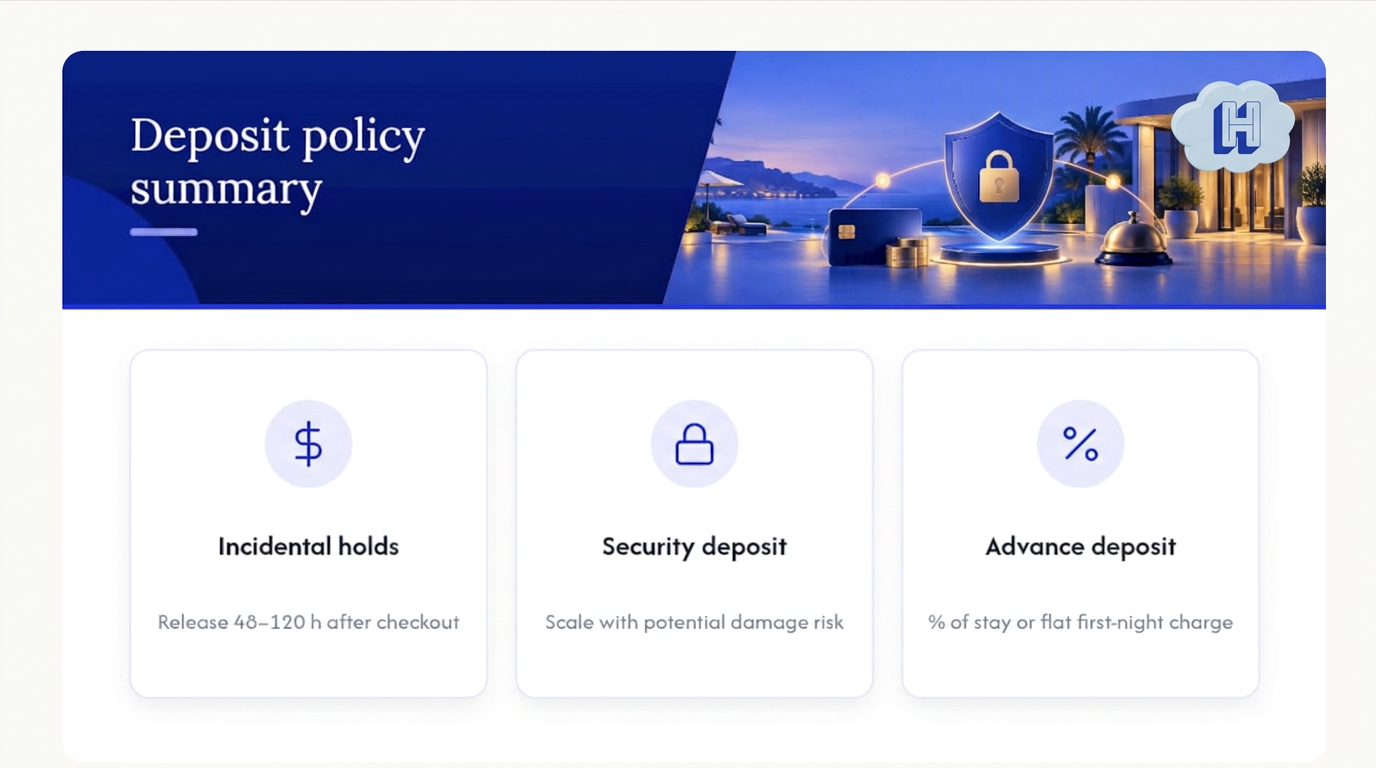
Amounts vary by property type and risk level, but a few patterns hold across independent hotels. Incidental pre-authorizations commonly vary depending on room rate and property class, security deposits tend to scale with potential damage risk, and advance deposits are often set as a percentage of the total stay or a flat first-night charge.
One rule protects both your cash flow and your guest relationships: release holds within days of checkout, not weeks. Card networks and processors set the technical limits, but a good target for independent hotels is releasing incidental holds within 48 to 120 hours after checkout, accounting for weekend and holiday processing delays.
Seasonality and property class should shape your numbers too. A boutique inn during a slow week can afford a lighter touch than a resort during a festival weekend, when high demand and higher no-show risk both justify a firmer deposit. The goal isn’t to maximize what you hold, it’s to hold enough to cover real risk without making booking feel like a hassle.
When and how to collect deposits: timing, channels, and payment methods
Timing changes the guest experience more than most hoteliers expect. Collecting at booking guarantees revenue early but can feel aggressive for a guest who’s still deciding. Collecting at check-in feels friendlier but leaves you exposed if the guest cancels late or never shows.

A blended approach works well for most independent properties: take a modest advance deposit at booking to guarantee the reservation, then handle incidentals with a pre-authorization at check-in.
A few operational details matter here:
- Capture the card expiry, CVV, and billing zip for every pre-authorization, since processors need them to authorize a card-not-present hold.
- Keep a card on file through your PMS rather than re-entering details manually, which cuts errors and speeds up refunds.
- Automate refund triggers so a released hold or a completed refund doesn’t depend on someone remembering to click a button.
- Watch surcharge rules if you add a card-processing fee. State laws vary widely, and some states cap surcharges or require specific signage, so you need to follow both state-level surcharge rules and your card network’s own requirements.
Because those rules are fragmented across states, many independent hotels skip surcharging entirely and build a small buffer into their room rates instead. It’s less to manage and it avoids a compliance headache that rarely pays for itself at a small property.
How to write a clear deposit policy and communicate it to guests
A deposit policy only works if the guest actually understands it before they book, not after they’ve been charged. Every policy needs the same core elements: the amount, when it’s collected, the conditions for a refund, examples of what counts as a deduction, and a simple way to dispute a charge.
Here’s language you can adapt directly for your booking page or confirmation email:
- “A deposit of [amount] is charged at booking to guarantee your reservation. This amount is refundable up to [X] days before arrival.”
- “A security hold of [amount] will be placed on your card at check-in and released within [X] hours of checkout if no damage or additional charges apply.”
- “Cancellations made less than [X] hours before arrival forfeit the deposit.”
Front desk staff need a script too, not just a policy document. Something like: “We’re placing a hold of [amount] on your card for incidentals. It’s not a charge, it’ll drop off automatically within a few days unless something’s added to your folio.” That one sentence prevents most confused calls to the front desk later.
Pro Tip: Put the deposit terms on the booking page itself, not just in a confirmation email the guest might not read until after they’ve paid.
Managing disputes, refunds, and chargebacks
Most disputes come down to documentation, and most hotels lose them because they didn’t collect enough of it at the time. Before you deduct anything from a deposit, gather the evidence.
- Photograph the room with a timestamp before and after the stay if damage is a possibility.
- Log the inspection in your PMS so there’s a record tied to the reservation, not a sticky note.
- Get a guest sign-off where possible, even a quick text or email acknowledgment of the charge.
Refund timing matters just as much as documentation. Release a hold or issue a refund as soon as the inspection clears, and tell the guest when it’s done, since a hold that lingers on a statement is one of the most common sources of guest frustration.
Matching the final settlement card to the card used for the initial incidental hold speeds reconciliation and reduces the risk of stranded holds and guest disputes.
That single habit, charging the same card you held, is one of the simplest ways to avoid a messy dispute later.
Operational best practices: a checklist for front desk and revenue teams
A deposit policy is only as good as the routine that enforces it. Build these habits into daily and monthly operations:
- Check outstanding holds daily so nothing sits unreleased past your policy window.
- Review pending refunds every morning and clear anything older than 24 hours.
- Standardize hold amounts in your PMS so front desk staff aren’t guessing room by room.
- Automate refund notifications so guests know the moment a hold drops or a refund posts.
- Pull a monthly dispute report to catch patterns, like a specific room type or rate plan generating more chargebacks than others.
| Routine | Frequency | What it catches |
|---|---|---|
| Outstanding hold review | Daily | Holds that should have released already |
| Pending refund check | Daily | Refunds stuck in processing |
| Dispute and chargeback report | Monthly | Patterns tied to specific rates or rooms |
These aren’t complicated tasks, but they’re the ones that get skipped when the front desk is busy, and skipping them is exactly how a small hotel ends up with a stack of guest complaints about a $75 hold that never released.
Author perspective: operational tradeoffs and where to be flexible
Strict deposit rules protect revenue, but they’re not free. Every extra dollar you hold or every non-refundable rate you push can cost you a booking from a hesitant guest, especially at a small property where word of mouth and repeat stays matter more than they do at a big chain.
Our take: be firmer on advance deposits for high-risk dates and looser everywhere else. A repeat guest booking a quiet Tuesday doesn’t need the same friction as a stranger booking a holiday weekend. Automation helps here too, since a system that handles holds and refunds without staff intervention lets you soften your public-facing rules without taking on more actual risk. The properties that get this right treat deposits as a tool for specific situations, not a blanket rule applied out of habit.
Hotelia Team
How a direct-booking platform and PMS can simplify deposit management
Deposit rules are only as reliable as the system enforcing them, and that’s where a lot of independent hotels lose money without realizing it. A missed refund or a hold that never releases isn’t just an accounting error, it’s a guest who won’t book direct again.

A suitable all-in-one platform for independent and boutique hotels includes a direct booking engine, a property management system, and built-in upsells, all running on the hotel’s own website. Payments settle through Stripe Connect, so you’re the merchant of record and the deposit logic runs on rules you set, not a third-party OTA’s terms.
- Pay in full at booking: Guests pay for the stay in full at booking, so the revenue is secured before arrival.
- Set your own deposit hold: You set your own deposit amount, and it’s authorized as a hold at check-in or self check-in, visible in Stripe right away.
- Automatic release at checkout: At checkout, the hold releases automatically, after you’ve charged any incidentals or add-ons and checked the guest out.
- Keep 100% of every direct booking with 0% commission, since what you collect stays yours in full.
Hotelia Pro is a flat monthly plan built for properties handling exactly this kind of payment complexity, and pricing details are available if you want to see how it fits your property.
Sources
These sources back the operational and compliance points above:
- Credit card surcharge laws by state (AllayPay)
- How to prevent hotel no-show and last-minute cancellations (HFTP)
- Best Western FAQs about reservations and deposits
FAQ
What is the hotel deposit policy?
A hotel deposit policy is the set of rules a property publishes about when it collects money or places a hold to guarantee a reservation or cover incidentals. It typically covers the amount, timing, refund conditions, and what counts as a valid deduction.
Are hotel deposits mandatory?
Deposits aren’t required by law in most cases, but many hotels choose to require them to guarantee revenue and reduce no-shows. Large chains commonly use a credit card guarantee at booking, and independent properties often follow similar practices to protect against last-minute cancellations.
What can a hotel keep your deposit for?
A hotel can typically keep part or all of a deposit for a no-show, a late cancellation outside the policy window, or documented room damage. Clear documentation, like dated photos and inspection logs, is what actually protects a hotel if a guest disputes the deduction.
How long does a hotel hold a deposit or pre-authorization?
Hold durations vary by processor and card network, but a common target for independent hotels is releasing incidental holds within 48 to 120 hours after checkout. Weekend and holiday processing can add extra time before the hold fully drops off a guest’s statement.
Should small hotels charge non-refundable deposits?
Non-refundable deposits work well for high-risk dates or discounted rates but can discourage bookings if applied everywhere. Many independent hotels find a lighter touch works better for repeat guests and low-risk dates, saving stricter terms for peak periods.
Recommended
Thanks for reading The Hotelia Dispatch!
Subscribe to get new posts delivered to your inbox.
See Hotelia in Action
Hotelia is a modern booking engine and property management platform built specifically for independent hotels. Keep more of what you earn with 0% commission on direct bookings.