
How to Run an Independent Hotel Without the Tool Chaos

To run your hotel without the daily scramble, put the few things that must be consistent (your rates, your payments, your guest data, your room status) on one system, instead of logging in to three different tools to answer a simple question like "how many rooms are we selling this weekend?" Then give your team one clear place to see it.
This guide is for owners and hands-on operators of a single independent or boutique hotel, inn, lodge, or retreat. We will walk through what to standardize, who owns what, how to staff it, and what to look for in software.
Table of Contents
- Why the chaos usually isn’t the guests
- The four problems that show up first
- Step 1: write a one-page standard
- Step 2: decide who owns what
- Step 3: plan for staffing, not just software
- Step 4: put your bookings on one foundation
- Step 5: run the front desk and housekeeping from one view
- Step 6: earn more from each stay
- A simple weekly rhythm
- What to look for when choosing software
- Our perspective: simple beats clever
- See how Hotelia fits your hotel
- FAQ
- Sources
Why the chaos usually isn’t the guests
Most owners assume a busy hotel feels chaotic because of the guests. It usually isn’t. It is the tools. A booking engine from one company, a property management system from another, a spreadsheet for housekeeping, an upsell plugin bolted on the side, and a payment tool that does not talk to any of them. You end up being the integration layer, keeping it all in sync in your head.
The fix is not more software. It is fewer places for information to live, and one clear owner for each decision.
The four problems that show up first
If you run your hotel on a patchwork of tools, you will recognize these.
- Too many systems. Your booking tool, your room-status spreadsheet, and your front desk notes all live in different places, and nobody has the full picture.
- Duplicate work. The same rate change gets entered twice. The same welcome email gets rewritten for every guest.
- Communication gaps. Housekeeping knows a room is ready, the front desk does not. A maintenance issue gets mentioned once and forgotten.
- Limited visibility. You find out about a slow weekend after it has already happened.
None of these are people problems. They are setup problems, and you can fix them in a sensible order.
Step 1: write a one-page standard
Before you pick or change software, decide how your hotel runs, on one page. A good starting list:
- Rate rules. Who can change rates, how low they can go, and how you handle minimum stays.
- Direct booking promise. What a guest gets for booking on your own website, such as a better rate, flexible cancellation, or a free add-on.
- Check-in and check-out standards. Times, how early arrivals are handled, and how late checkouts are priced.
- Guest communication basics. Which confirmations and reminders go out, and in what tone.
- Housekeeping and maintenance routines. How a room goes from dirty to clean to inspected, and how an issue gets logged.
- Reporting rhythm. Which numbers you look at each week, and who checks them.
Write it down once, and your team stops guessing. New staff get up to speed in a day instead of a month.
Step 2: decide who owns what
A hotel runs better when each decision has one clear owner. In a small independent hotel, that is often you for some things and your front desk for others.
You own the rate rules, the payment setup, the software, and the standard above. Your front desk owns the daily schedule, fixing a guest’s problem in the moment, and the local relationships that make a stay feel personal.
Put your attention where guests meet your team. The 80/20 idea applied to hospitality, as described in this hospitality overview, points to giving training and authority to the roles that meet the most guests, like the front desk, rather than spreading attention evenly. When a front desk agent can fix a problem on the spot, the guest remembers the recovery, not the problem.
Step 3: plan for staffing, not just software
Staffing is the quiet pressure behind everything else. According to AHLA’s Front Desk Feedback Survey from early 2026, more than half of U.S. hotel properties report being somewhat or severely understaffed, and 65% of operators cite labor costs as a top financial pressure.
With a lean team, the goal is to remove work, not add people. Look for tasks that repeat and should run themselves:
- Booking confirmations and other essential guest emails.
- Housekeeping task lists that update when a guest checks out.
- Maintenance logs that keep a record instead of relying on memory.
- Payments that settle without someone reconciling them by hand.
Every hour your front desk does not spend retyping a reservation is an hour they can spend with a guest.
Step 4: put your bookings on one foundation
This is where a lot of independent hotels lose money without noticing. If your booking process is a patchwork, you cannot see what is working, and you cannot learn from it.
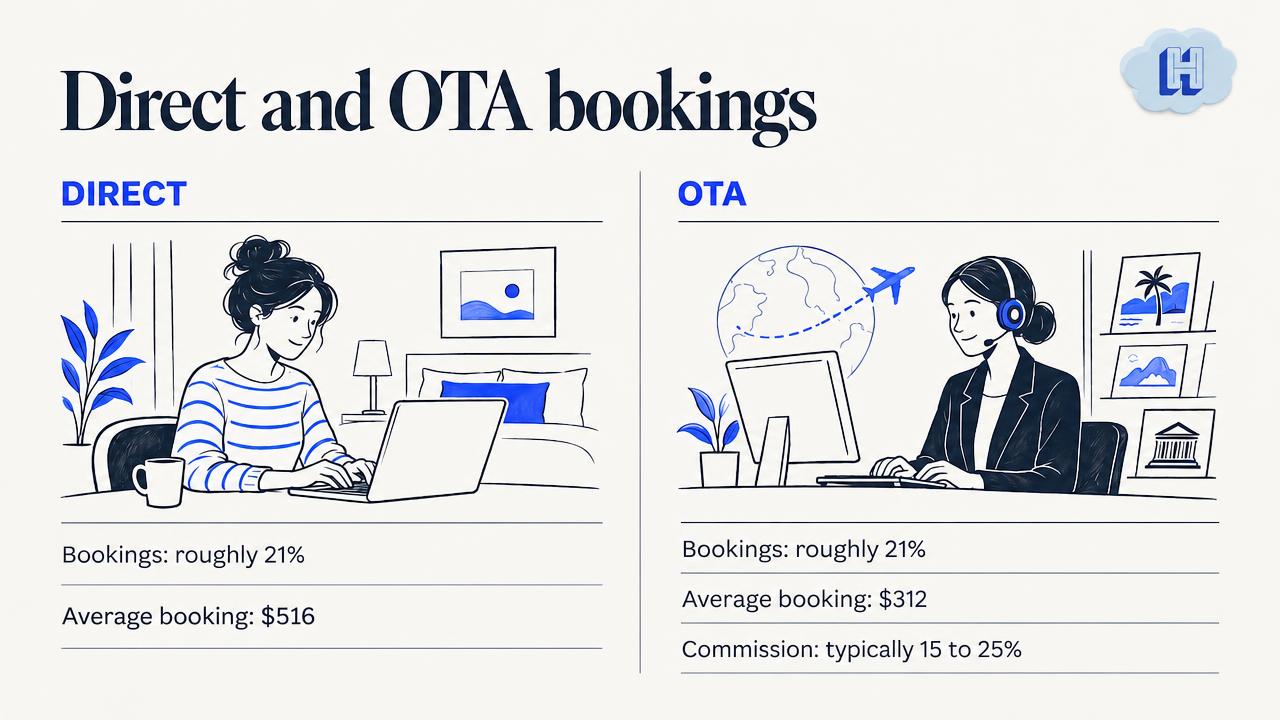
Direct bookings are where your margin is. OTAs bring guests, and they are not going away. The 2025 State of Distribution Report shows direct bookings and OTAs each at roughly a fifth of total hotel bookings. But the cost is not equal. OTA commissions typically run 15 to 25% of booking revenue, and can reach 30% on some channels. Reporting on SiteMinder data also found hotels with strong direct platforms average around $516 per booking, against about $312 for OTA bookings, partly from room choice and add-ons, partly from the commission you keep. Treat those as industry figures, not a promise for your property. The direction is clear: a guest you convert on your own site is worth more than the same guest arriving through an OTA.
Whatever setup you choose, check for these:
- Your own website, not a redirect. Guests should book without being sent to a third-party page.
- One simple checkout. A clean flow, branded to your hotel, so guests do not meet a wall of five different rate plans.
- Payments that go straight to you. Money should settle to your account, not sit with a middleman.
- Guest data you own. If a guest stays once, you should be able to recognize them the next time.
- Mobile-first booking. Most guests will check availability on a phone.
For a closer look at the booking flow itself, see our post on direct booking paths for independent hotels and the seven revenue leaks to fix.
Step 5: run the front desk and housekeeping from one view
A property management system is where reservations, check-in and check-out, and live room status come together. Three things matter most:
- Live room status. Is 204 clean, dirty, or out of service? The answer should be the same for the front desk and housekeeping, instantly.
- Task automation. Checkout triggers a cleaning task. A reported issue becomes a maintenance log entry with a date.
- Team collaboration. Everyone works from the same record instead of texts and sticky notes.
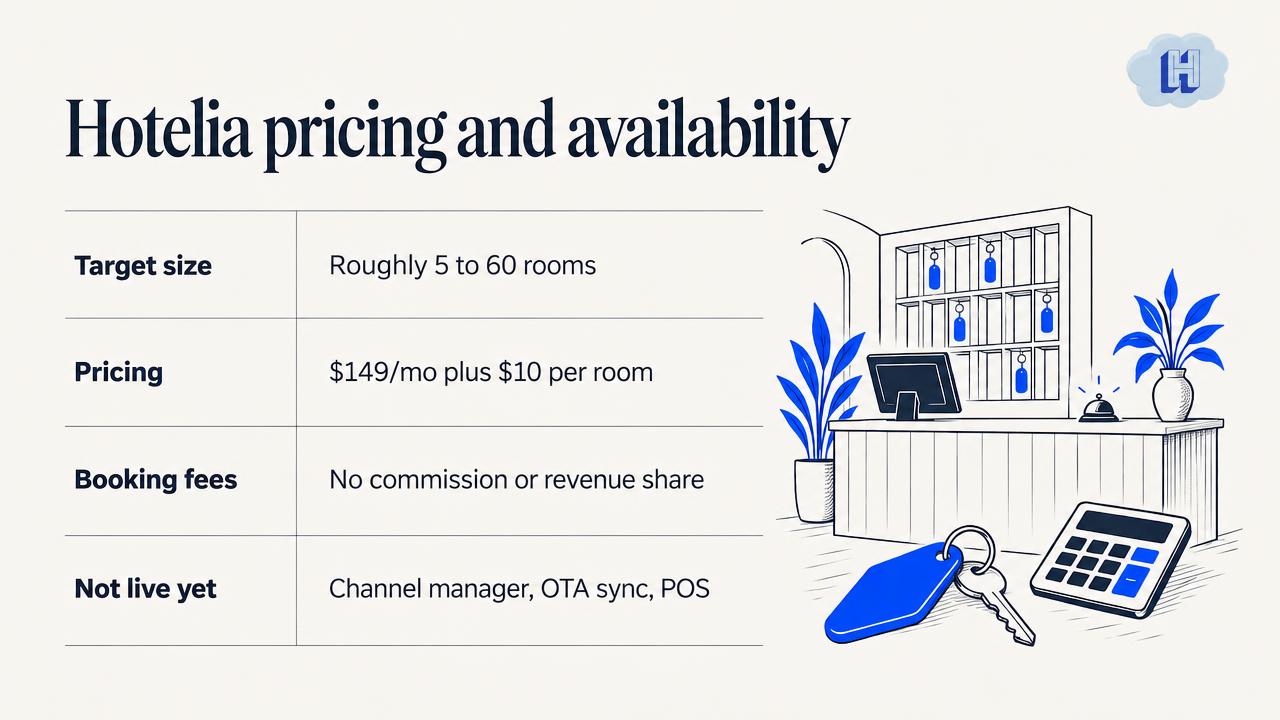
A note on what is and is not live. Hotelia does not yet offer a channel manager, OTA sync, or point-of-sale integration. Those are coming soon. If you currently rely on OTA connections to fill rooms, plan for that honestly: Hotelia is built to grow your direct channel and cut commission, not to replace every distribution connection today.
Step 6: earn more from each stay
Once your bookings are consistent, add-ons become a simple way to earn more. A late checkout, a bottle of local wine, a breakfast package, a pet fee, a spa credit: each is a small amount, but a guest who is already booking is the easiest person to sell to.
A few principles from Hotel Tech Insight’s look at upselling:
- Pre-arrival offers, sent 48 to 72 hours before check-in, get plenty of views but modest acceptance, so they work best with steady bookings.
- Offers do better when they sit inside the booking flow, not as a separate email no one opens.
- Personalizing by past stays beats a generic offer to everyone.
Hotelia’s Revenue Builder is our upsell tool, built into the checkout. Add-ons are priced flat, not per night, and we take no commission or revenue share on them. One boundary to know: the built-in guest emails are essential transactional emails, such as booking confirmations. Marketing sequences, like a post-stay offer, run through Klaviyo, not through Hotelia’s built-in emails.
A simple weekly rhythm
Tools only help if you use them on a schedule. Here is a rhythm that works for a lean team.
- Monday morning: review the coming 14 days of reservations and spot slow, low-demand dates. Adjust rates inside your own rules.
- Daily: check room status, open tasks, and the maintenance log.
- Midweek: look at your direct booking share and add-on sales.
- Friday: review guest feedback and anything your team had to fix.
- Monthly: compare this month to last on occupancy, average rate, and add-on revenue.
Keep it boring. A routine you follow beats a dashboard you admire.
What to look for when choosing software
You will see many tools. Compare them by what they actually include, not by the length of the feature list.
- Large enterprise suites are built for chains with dedicated IT and big budgets. For a 5 to 60 room independent, they are usually more than you need.
- Stitched-together stacks, a booking engine from one vendor, a PMS from another, an upsell plugin from a third, work, but you are the one keeping them in sync and paying for each.
- All-in-one platforms combine the booking engine, property management, and upsells in one system. Fewer logins and fewer handoffs fit a lean team.
Whatever you choose, ask these questions:
- How is it priced, and what does it cost as I add rooms?
- Do I pay commission on direct bookings or add-ons?
- Where do payments settle, and who owns the guest data?
- Can my team use it without IT support?
- What is live today versus on a roadmap? A feature that is "coming soon" cannot help you this season.
Our perspective: simple beats clever
We built Hotelia for independent and boutique hotels, inns, lodges, and retreats, roughly 5 to 60 rooms, run by hands-on operators. When we talk to owners, we hear the same thing: the work is not harder because of the guests. It is harder because of the tools.
Our view is that a small hotel needs three things to work together. A direct booking engine on your own website, so you keep 100% of every direct booking. A property management system, so your team shares one view of reservations and room status. And built-in upsells, so each stay earns a little more. We think those belong in one place, not three.
We also think you should be told plainly what is not here yet. A channel manager, OTA sync, and point-of-sale are on our roadmap, not in the product today. We would rather you decide with clear information.
See how Hotelia fits your hotel
Hotelia is an all-in-one platform with a direct booking engine, a full property management system, and the Revenue Builder upsell tool, all on your own website. Payments settle to you through Stripe, and the guest data stays yours.
Pricing is a flat $149 per month plus $10 per room, with Revenue Builder available as a $50 per month add-on. There is no commission or revenue share on bookings or add-ons, and there is a free trial. See the pricing page for details, or look at the booking engine to see the 0% commission model.
FAQ
What is the hardest part of running a small hotel?
For most owners it is not the guests, it is keeping a patchwork of tools in sync: a booking engine, a separate property management system, a spreadsheet for housekeeping, and a payment tool that does not talk to the rest. Putting those on one system removes most of the daily friction.
Do I need a property management system for one hotel?
If you want to avoid manual work, yes. A property management system keeps reservations, room status, check-in and check-out, and housekeeping in one place, so your team is not retyping bookings or guessing which room is ready.
How do I get more direct bookings without discounting everything?
Give guests a clear reason to book on your own site, such as a small perk or a better cancellation policy, keep the checkout fast and on your own domain, and own the guest data so you can bring them back. Our direct booking guides go deeper on this.
Does Hotelia replace my OTA connections?
No. Hotelia focuses on direct bookings at 0% commission, plus property management and upsells. A channel manager and OTA sync are coming soon and not live today, so keep any OTA connections you rely on handled separately for now.
Sources
- More Hotels, More Problems? Scaling Smarter in Hospitality, Hospitality Net
- How to use the 80/20 rule in hospitality, 8020
- AHLA Front Desk Feedback Survey, early 2026
- The State of Distribution Report 2025
- Hotel direct bookings remain stable despite rise of AI, Web in Travel
- Hotel Upselling 2026, Hotel Tech Insight
Thanks for reading The Hotelia Dispatch!
Subscribe to get new posts delivered to your inbox.
See Hotelia in Action
Hotelia is a modern booking engine and property management platform built specifically for independent hotels. Keep more of what you earn with 0% commission on direct bookings.