
The Hotelia Dispatch
Introducing the Hotelia AI Booking Assistant
Take a booking in a sentence, at the desk, on the phone, or from anywhere in the hotel.
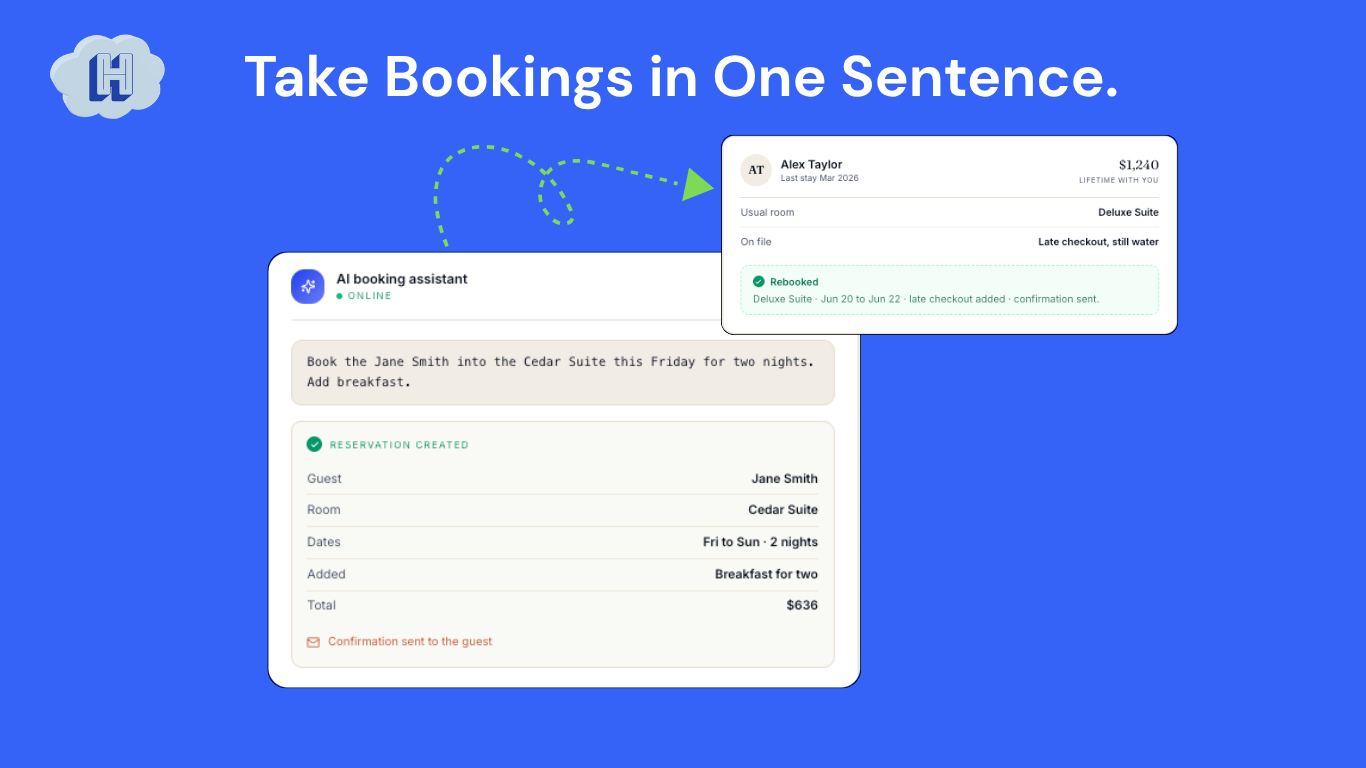
There's a moment at a lot of small hotel front desks that nobody means to create.
A guest walks in. The person at the desk says hello, then turns to the screen. Now come the clicks. New reservation. Pick the room. Enter the dates. Tab over to the rate. Add the guest. The guest is still standing there. The warm hello has gone quiet. The host is fumbling through steps, and the guest can see it, because the host is staring at a screen instead of at them.
It's a small thing. It's also the whole thing. That silence is friction, and the guest feels it before they've even reached their room.
We built our booking assistant to close that gap.
What Hotelia is, and who it's for
Hotelia is a booking and property platform for independent and boutique hotels. Not the big chains. The 5 to 60 room places with a real front desk, a small team, and an owner who knows the regulars by name.
You take direct bookings on your own website and keep all of the revenue. You run the property from one place. Reservations, guest details, confirmations, the daily flow of who's arriving and who's leaving.
We built it for operators. The owner who is also the manager. The manager who is also covering the desk on a Saturday. The people who got into hospitality because they like people, and then spent years fighting software built for someone ten times their size.
We know that fight because we came up through it. We've worked the desk. We've worked for the big brands. We've spent years in tech too. Hotelia is the tool we wanted back when we were on that side of the counter.
Why we built the booking assistant
Taking a booking should be the easy part. Someone walks in or calls. You already know the answer. The room, the nights, the rate. But the software makes you stop, turn away, and enter it field by field while the guest waits. So the front desk fumbles, and a moment that should feel like hosting starts to feel like paperwork.
We didn't want operators choosing between the task and the guest. So we built an AI booking assistant for the person behind the desk. Not for the guest. For you.
You tell it who's coming and when. You add the room and any extras, like a late check out or breakfast. It builds the reservation in Hotelia, prices it, and sends the confirmation on its own. You never break eye contact. You keep your social hat on. You stay the host.
It works the same on the phone. And it works when you're nowhere near the desk. Say you're turning a room or out in the garden and a call comes in. Open the app, tell the assistant what to book and for who, and it's done. No scrap of paper in your pocket. No sticky note to transcribe when you finally get back to the desk. The booking is already in the system and the guest already has their confirmation.
The AI Booking Assistant is the backend that remembers. If it's someone who's stayed before, it's even shorter. Tell it who's coming back and it rebooks them in one line, with their room and their preferences already there.
That's the whole idea. It does the typing. You do the hosting.
Guest-facing vs operator-facing AI assistants: what matters for hotels?
The split comes down to who the AI talks to. Guest-facing assistants answer visitors on your website, often in multiple languages, and nudge them toward booking. Operator-facing assistants talk to your team instead.
That changes what each one is evaluated on:
- Guest-facing tools are judged on response speed, language coverage, and how cleanly they escalate to a staff member with the full conversation when a question is too complex.
- Operator-facing tools are judged on whether they can actually execute the reservation, how deep their access to your property system goes, and how much control your team keeps over what gets sent to the guest.
A guest-facing chatbot automates the conversation before a booking happens. An operator-facing assistant, like Hotelia's, automates the data entry after your team already has the answer, so front desk staff spend less time on fields and more time on the person in front of them.
If your biggest friction point is a guest waiting on hold or browsing your site at midnight, a guest-facing tool addresses that. If it's your team stuck re-typing the same reservation details while a guest waits at the desk, that's the gap an operator-facing assistant closes.
Integrations that matter: What to look for in a hotel booking assistant AI
Before picking a hotel booking assistant AI, check which systems it actually connects to. Here's the checklist worth running through:
- Property Management System (PMS): does it read and write reservations directly, or just flag them for manual entry?
- Channel manager: does it sync availability across OTAs, or is that still a manual task?
- Hotel website: does it embed into your existing booking flow, or require a separate widget?
- Payments: does it connect to a secure processor like Stripe for direct payments?
- Tracking and schema: does it support Google Tag Manager and hotel schema so your booking data feeds your analytics?
PMS and channel manager connections often carry their own setup cost, since they require matching each property's specific setup.
Hospitality is human
This is the line we keep coming back to. Hospitality is human and it's personal. The point of a small hotel is that a person is looking after you. A machine can't welcome someone. A machine can't read a tired traveler and quietly offer the room at the back before they ask.
So we made a decision early. Your guest never talks to our AI. There's no bot in the chat pretending to be a person. There's nothing standing between you and the people you're there to host. The assistant stays behind the desk, on your side of it, doing the part that was never the hospitality in the first place.
The kind of AI hospitality actually wants
A lot of hotel people are wary of AI right now, and we understand why. The fear is that AI gets pointed at the guest. That it swaps the warm voice for a script. That the thing making an independent hotel special gets automated away to save a few dollars.
We share that fear. If AI in hospitality means a chatbot answering your guest instead of you, it's solving the wrong problem. The guest moment is the one thing you should protect.
But there's a quieter kind of AI that almost nobody argues with. The kind that takes the busywork off your team so they can do more of the human part, not less. It's boring on purpose. It just wants to give you your time back.
So we'll leave you with the question we keep asking ourselves. Not whether hospitality wants AI, but which kind. Do you want AI that talks to your guests, or AI that clears the path so you can? What would you let a machine do in your hotel, and what would you never hand over?
Come tell us at booth 356 at the Miami Independent Hotel Show in September. We're building this in the open, and it's for you.
See it live
See the AI Booking Assistant in action, and try it with your team. Visit hotelia.io/ai-booking-assistant.
Thanks for reading The Hotelia Dispatch!
Subscribe to get new posts delivered to your inbox.
See Hotelia in Action
Hotelia is a modern booking engine and property management platform built specifically for independent hotels. Keep more of what you earn with 0% commission on direct bookings.