
Stripe for Hotel Payments: A Practical Guide for Independent Hotels

Stripe works well for hotel payments when it is connected to the system that holds your reservations. On its own, it is a card processor. Tied into your booking engine and property management system (PMS), it becomes the way direct bookings turn into money in your bank account, with every deposit, refund and incidental matched to the right guest.
This guide is for owners and operators of small and boutique hotels, inns and lodges. It covers what Stripe costs, what hotels need from it that a web shop does not, where things go wrong, and how to set it up so your team spends its time on guests, not spreadsheets.
Key takeaways
- Stripe’s standard US pricing is 2.9% + 30 cents per successful domestic card transaction, so the processor fee is a fraction of what many booking channels take as commission.
- Hotels need more than “charge and settle”: holds for incidentals, deposits and longer capture windows matter, and your software has to support them.
- The biggest day-to-day pain is rarely Stripe itself. It is a booking engine, PMS and payment tool that do not talk to each other.
- Clear deposit and cancellation rules protect you from disputes more than any setting does.
- Offer the payment methods your guests expect, including cards first and digital wallets next.
Table of Contents
- What Stripe does for a hotel
- What Stripe costs, with a worked example
- What hotels need that web shops do not
- Where hotel payments go wrong
- Which payment methods guests expect
- A simple setup checklist
- Our perspective: payments belong inside the booking flow
- How Hotelia fits in
- Frequently asked questions
- Sources
What Stripe does for a hotel
A payment processor does three jobs for you. It authorizes the guest’s card, moves the money to your bank, and records what happened so you can refund or adjust later. Stripe describes hotel payment processing as how you accept and move money from guests into your account, whether that is at the front desk, through an online booking, or via a room charge.
For a direct booking, the flow looks like this:
- A guest picks dates and a room on your own website.
- They enter a card, or use a wallet, at checkout.
- Stripe authorizes the payment and settles the funds to your account.
- Your PMS records the payment against that reservation.
Step 4 is the one hoteliers underestimate. We come back to it below.
What Stripe costs, with a worked example
On its public pricing page, Stripe lists 2.9% + 30 cents per successful transaction for domestic cards. The same page adds extra percentages for manually entered cards, international cards and currency conversion. Check it before you plan, because pricing can change.
Here is what that means for a typical stay. Say a guest books two nights at $240 a night, so $480 in total.
| Item | Amount |
|---|---|
| Booking total | $480.00 |
| 2.9% of $480 | $13.92 |
| Fixed fee | $0.30 |
| Processing fee | $14.22 |
| What reaches you | $465.78 |
That is the card fee on a domestic card, and it is the only cost in that example. Many guests also book through channels that charge a percentage commission on top of card fees. The point is not that card fees are free. It is that on a direct booking you pay a processor for moving money, not a middleman for the guest.
A few other fee points to plan for:
- Disputes cost money. A Stripe dispute fee of $15 per instance was reported on a third-party page describing standard US pricing. Confirm the current figure in your own Stripe dashboard.
- International guests cost more. Foreign cards and currency conversion add to the base rate, as the pricing page shows.
- Manual entry costs more. Typing a card number in yourself is priced higher than a guest paying through your checkout. Another reason to push guests to book online.
What hotels need that web shops do not
A web shop charges a card once and ships a box. A hotel charges a deposit months ahead, holds funds for incidentals, and often adjusts the bill during the stay. Three card features matter most.
Holds for incidentals
A preauthorization reserves funds on the guest’s card without taking them. Stripe explains that a temporary hold, also called preauth, is a core processing practice used in both in-person and online payments. Hotels use it at check-in to cover the minibar, damage or a late checkout.
Raising a hold during a stay
If a guest extends by two nights or runs up a larger tab, the original hold may fall short. Stripe’s documentation on incremental authorization covers increasing an authorized amount before you capture it. It also lists limits, such as a maximum number of increment attempts per payment, so read it before you design your process.
Longer windows for early bookings
Card authorizations expire. Stripe’s research notes describe a standard capture window of 7 days that can be extended up to 30 days for certain flows, with the details in the flexible payments documentation. For a guest booking six months out, that is why many hotels charge a deposit at booking and the balance later, instead of holding a card for months.
Here is the catch. Each of these features has to be supported by the layer between Stripe and your PMS. Stripe can offer the tool, but your software has to use it. Ask any vendor, ours included, exactly which of these flows it supports today.
Where hotel payments go wrong
Disconnected systems
Stripe’s own guide on hotel payment integrations puts the issue plainly: transaction data should flow automatically from your payment tools to your core systems, instead of being keyed in or reconciled by hand. When it does not, someone on your team exports a payout report each week and matches it against reservations line by line.

For a hotel with 5 to 60 rooms and a lean team, that is hours that could go to guests. It is also where mistakes creep in: a refund that never got recorded, a deposit applied to the wrong stay.
The fix is a platform where the booking engine, PMS and payments are one system. If you are weighing options, our guide to PMS and booking engine integration tests gives you six checks to run before you commit. For a view of how automated folio handling looks in practice, this overview of folio-integrated charges shows how a charge ties back to a guest account.
Token portability
Stripe’s integration guide also raises a point owners rarely ask about: if you ever change providers, can you move the stored guest card tokens? Without that, you may have to ask every guest with a future stay to enter their card again. Before you sign any contract, ask the question in writing.
Disputes and chargebacks
Most disputes in hotels come from unclear terms: a guest who did not realize a deposit was non-refundable, or who did not recognize the charge on a statement. Three habits help:
- Show the deposit and cancellation policy on the checkout page, not only on a separate policy page.
- Use a statement descriptor guests will recognize, ideally your hotel name.
- Send a clear confirmation email straight after payment.
We wrote a full playbook on this in Stop Chargebacks: Deposit Policy Playbook for Independent Hotels.
Account holds and reviews
Payment providers review accounts, and businesses with high refund or dispute rates can face extra scrutiny. We cannot tell you how any provider will treat your account, and we would not promise it. What you can control is your own record: honest descriptions, a clear policy, prompt refunds when you owe them, and few disputes. Keep a second way to collect payment, such as a bank transfer option for group bookings, so one problem never stops you from taking a reservation.
Which payment methods guests expect
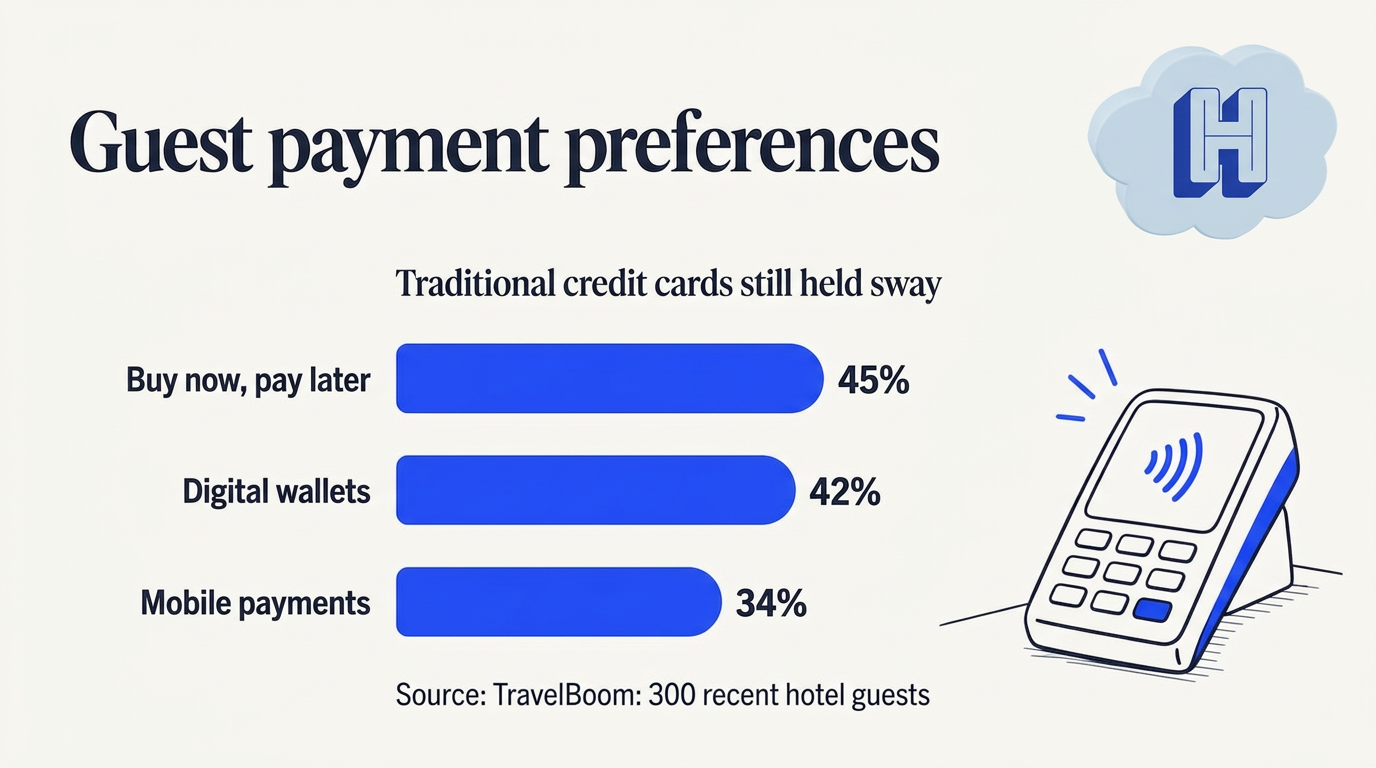
Cards still lead. In a TravelBoom study of 300 recent hotel guests, traditional credit cards still held sway, while interest in flexible options was notable: buy now, pay later appealed to 45% of respondents, digital wallets to 42%, and mobile payments to 34%. The same study found that payment preferences vary with age and income, so a hotel with a younger leisure crowd may see more wallet use than one that hosts business travelers.
Digital wallets are worth a look on their own. Planet's guest sentiment research points to rising demand for wallet payment in hotels, with interest notably higher in the US than in several European markets. That is guest sentiment, not a promise about your conversion rate, but it tells you which button is worth adding to your checkout.
For more on how wallets affect bookings, read why payment models decide Apple Pay hotel bookings.
A simple setup checklist
Here are the places to look, in the order we would tackle them.
- Decide when guests pay. Full prepayment, a deposit with the balance at arrival, or a card guarantee only. Match it to your season and your cancellation window.
- Write the policy in plain words. Say how much is charged, when, and what is refundable. Put it on the checkout page.
- Confirm what your software supports. Ask about deposits, refunds from the reservation, holds at check-in and raising a hold during a stay.
- Check reconciliation. Make a test booking, refund part of it, and see whether your PMS shows both without any typing.
- Check payout timing. Know how long it takes from payment to your bank account, and how your accountant will see it.
- Reduce your card data exposure. Using a hosted, tokenized checkout means card numbers stay out of your own systems. Our guide to PCI compliance for independent hotels shows three ways to shrink your scope.
- Ask about leaving. Get the token portability answer before you start.
Our perspective: payments belong inside the booking flow
We built Hotelia because independent hotels were stitching together a booking engine, a PMS and a payment tool, then paying for the gaps in staff time. Our view is simple: the payment should be part of the reservation, not a separate chore.
That is why guest payments on Hotelia are powered by Stripe, and why payments settle to your hotel. We charge 0% commission on direct bookings, so the Stripe processing fee is the cost of taking a card, not a cut of your revenue. The guest data belongs to you as well.
We would also say this: a processor does not fix a messy process. The hotels that have the easiest time with payments are the ones with a clear deposit policy, a booking flow that is short, and a system where the front desk sees what the guest paid without opening another tab. Start there, and the choice of tool gets much easier.
, Hotelia Team
How Hotelia fits in
Hotelia is an all-in-one hotel platform for independent and boutique hotels: a direct booking engine on your own website, a full property management system, and Revenue Builder, our upsell tool for add-ons at checkout, priced flat and not per night. Payments run through Stripe, and you can read how that works on our Stripe Connect page.
Pricing is a flat monthly fee per property plus $10 per month per unit, with no commission on bookings or add-ons and a free trial. See the pricing page for plan details, or look at our booking engine to see the direct booking flow.
Frequently asked questions
How much is the Stripe fee for $1,000?
On standard US pricing for a domestic card, it is 2.9% plus 30 cents, which is $29.30 on $1,000. International cards, manually entered cards and currency conversion add to that, according to Stripe’s pricing page. Always check the current rates in your own account.
What are the downsides of using Stripe for a hotel?
Stripe is a general payment tool, so hotel-specific work such as holds, deposits and matching payments to folios depends on the software connected to it. Disputes carry a fee, and international cards cost more. The risk drops a lot when payments are built into your booking engine and PMS.
What payment methods do hotel guests use most?
Credit and debit cards lead, followed by digital payment services, buy now, pay later and mobile wallets such as Apple Pay and Google Pay, per the TravelBoom study. Younger and lower-income travelers were more influenced by alternative methods. Offer cards first, then add the options your own guests ask for.
Do I need a PMS that connects to Stripe?
Yes, if you want to avoid manual reconciliation. Without a connection, someone has to match payouts to reservations by hand, which is slow and easy to get wrong. A PMS that records each payment, refund and incidental against the reservation saves that work.
Sources
- Stripe pricing and fees
- Stripe: Hotel payment processing explained
- Stripe: How integrated payment solutions for hotels work
- Stripe: Credit card holds explained
- Stripe documentation: Increment an authorization
- Stripe documentation: Flexible payment scenarios
- FundRazr: Stripe standard pricing summary
- TravelBoom: Flexible payment options study
- Planet: Global Guest Sentiment Report
Recommended
Thanks for reading The Hotelia Dispatch!
Subscribe to get new posts delivered to your inbox.
See Hotelia in Action
Hotelia is a modern booking engine and property management platform built specifically for independent hotels. Keep more of what you earn with 0% commission on direct bookings.