
Booking engine vs PMS: what each does and which you need
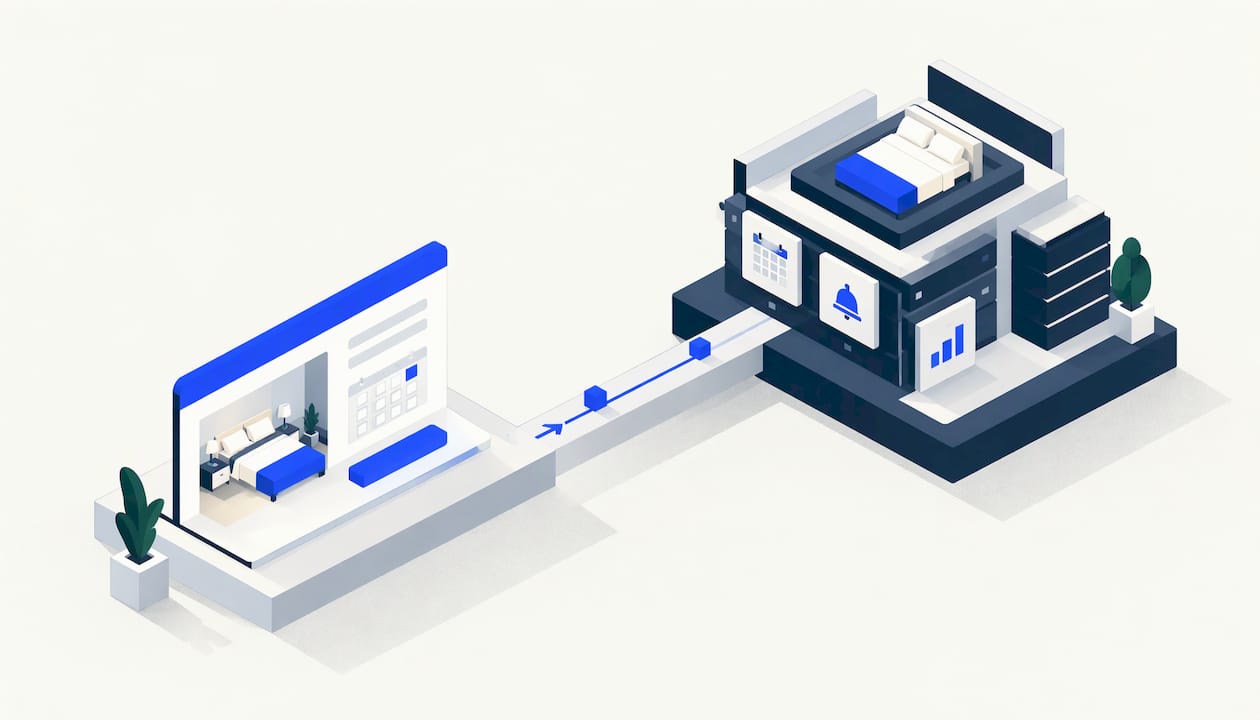
A booking engine is the part of your website where guests find rooms and pay. A property management system (PMS) is the software your team uses to run the hotel: reservations, check-in, room status, housekeeping and billing. One faces the guest, the other faces your staff.
An independent hotel needs both. The simplest way to run them is on one platform, so a booking made on your site lands at your front desk with no handoff in between. That's how Hotelia works: a direct booking engine, a property management system and built-in upsells, on your own website, at 0% commission.
Run bookings and hotel operations together
Hotelia is a modern booking engine and property management platform built specifically for independent hotels. Keep more of what you earn with 0% commission on direct bookings.
Book a DemoKey takeaways
- The booking engine sells rooms to guests on your website. The PMS runs the stay once the booking exists.
- You need both. A booking engine without a PMS leaves you retyping reservations. A PMS without a booking engine leaves your website as a brochure.
- The risk lives in the connection between the two. When bookings pass through extra layers, rates and availability can fall out of step.
- For a 5 to 60 room independent hotel, one platform that does both removes most of that risk, and a vendor bill.
- Hotelia is $149 a month plus $10 per unit, with 0% commission on bookings and add-ons.
The short answer: a storefront and a command center
Think of a small inn. The booking engine is the front door that stays open at 2 a.m. The PMS is the front desk, the room board and the housekeeping cart behind it.
Jordan Hollander, co-founder of Hotel Tech Report, draws the same line in Hospitality Net: the booking engine is "your digital storefront, optimized for guest conversion," while the reservations system is "your internal command center." Your guest only ever sees the storefront. Your team lives in the command center.
That's the whole difference. The rest of this guide covers what each one does, how they connect, and what to check so they never fall out of step.
What a booking engine does
A booking engine is the guest-facing tool on your own website. It shows live availability, rates and room types, and turns visitors into confirmed reservations. It's your "book now" button and everything behind it:
- The date picker and availability search
- Rooms and rates, with photos and descriptions
- Add-ons offered before checkout
- Payment, and the confirmation the guest receives
It's also where guests give up. SiteMinder's Changing Traveller Report 2025, which surveyed 12,000 travelers in 14 countries, found that 52% had abandoned an online booking because of a bad experience. A slow, confusing or off-brand checkout loses bookings you already worked to attract, often to an online travel agency (OTA) that charges you commission on the same guest.
Here's how the Hotelia booking engine works: it sits on your site, keeps guests on your domain, and charges 0% commission.
What a PMS does
A property management system runs the day-to-day of the hotel from one place: reservations, check-in and check-out, room assignments, rates, housekeeping, billing and guest records. Every booking, room status and charge passes through it. (A folio, which you'll see in most PMS software, is simply the running bill for a guest's stay.)
In a small hotel, the PMS is what your team opens to:
- Check a guest in and assign a room
- See which rooms are clean, dirty or out of service
- Add a late checkout or breakfast charge to a bill
- Check a guest out and close the folio
- Log a maintenance issue and hand it to the right person
A guest never sees any of this. But they feel it: a room that's ready on arrival, a bill that's right, a front desk that already knows their name.
Hotelia's property management system covers reservations, check-in and check-out and live room status, plus housekeeping, task automation and maintenance logging. Your team works from one screen instead of a notebook, a spreadsheet and three logins.
Booking engine vs PMS, side by side
| Booking engine | Property management system (PMS) | |
|---|---|---|
| Who uses it | Your guests | Your team |
| Where it lives | On your hotel website | Behind the scenes, on your team's devices |
| Main job | Turn visitors into paid reservations | Run reservations, rooms, billing and housekeeping |
| Key moment | Checkout on your site | Arrival, the stay and departure |
| What it needs from the other | Live rates and availability | Incoming bookings, guest details and payments |
| What goes wrong without it | Your website can't take direct bookings | Your team can't manage the stay reliably |
Look at the last row. Neither replaces the other. They're two halves of the same booking.
How the two work together
Connected properly, they form a loop. Hollander describes it in the same Hospitality Net piece: the guest books on your website, the booking engine sends the reservation to the reservations system, and that system updates inventory and triggers what comes next, such as pre-arrival emails, room assignment and upsell offers.
Here's that loop in a day at a small hotel:
- A guest searches dates on your website. The engine pulls live rates and availability.
- They choose a room, add an extra and pay.
- The reservation appears in the PMS, and the room is held so nobody else can book it.
- The front desk sees the arrival on the day's list. Housekeeping sees the room on the board.
- At checkout, the folio closes and the room goes back to "dirty" for the next turn.
The loop only works when every step is automatic and instant. That's where separate tools struggle.
Where the connection breaks
Hollander notes that some systems pass booking data through middleware or channel managers, which "can introduce delays or inaccuracies," and that when integrations don't communicate cleanly, hotels see double bookings and outdated rates. A double booking is the one every owner dreads: a guest arrives with a confirmation and there's no room.
The industry is used to this kind of complexity. A 2022 survey by Hotel Technology Next Generation (HTNG), cited in Hospitality Net, found that over 95% of hotels use a website booking engine for direct reservations, and that hotels use on average 20 separate on- or above-property systems. Every extra system is another connection that can lag, fail or cost money to maintain.
Do you need a booking engine, a PMS, or both?
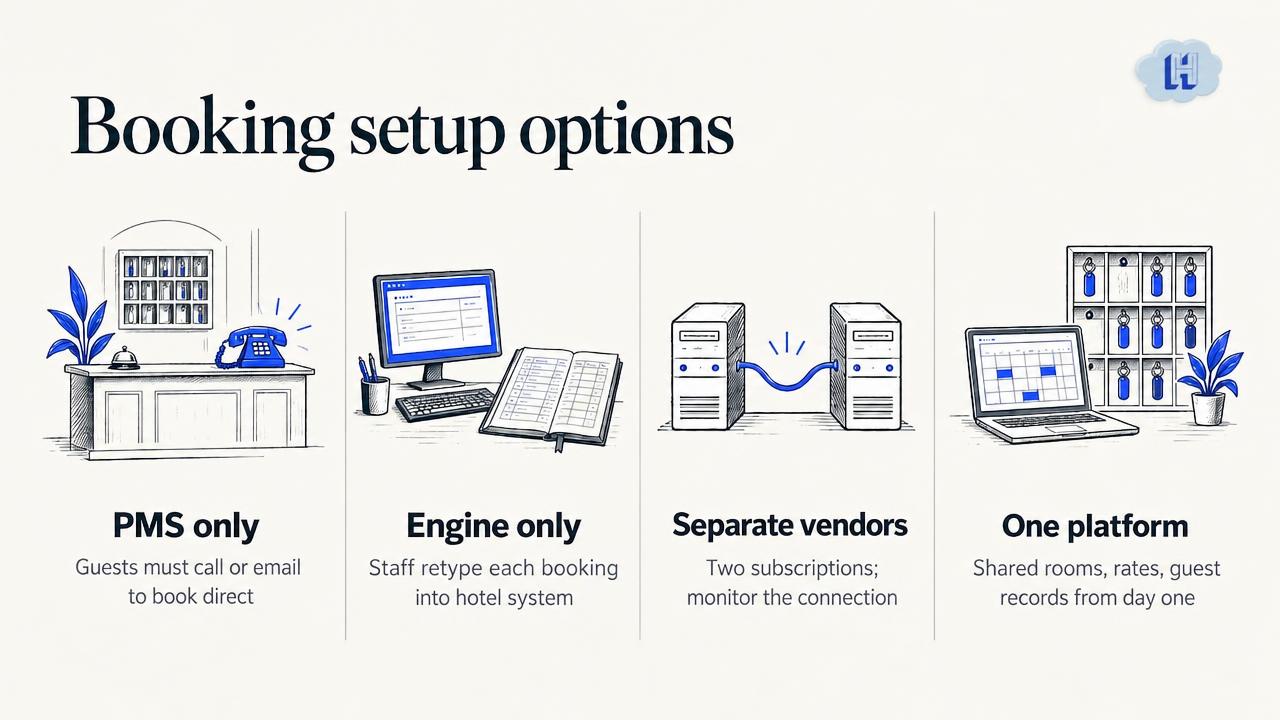
If you want direct bookings, you need both. Here's how each setup plays out.
Only a PMS. Your team runs the hotel well, but your website can't take a booking. Guests who want to book direct have to call or email, and many go to an OTA instead. You pay commission on bookings you could have kept.
Only a booking engine. Your website takes bookings, but your team has to move each one into whatever they use to run the hotel. That means retyping, mistakes, and a front desk that doesn't trust the room list.
Both, from separate vendors. This works when they're properly connected. It also means two subscriptions, two support teams, and a connection someone has to watch. When it breaks, each vendor can point at the other.
Both, on one platform. The booking engine and PMS share the same rooms, rates and guest records from day one. There's no sync to set up and nothing to reconcile. For a hands-on owner with a lean team, this is usually the lowest-effort route, and it's the one we recommend.
A word on channel managers
You'll hear a third term in the same conversations. A channel manager pushes your rates and availability out to OTAs, so every site you sell on shows the same rooms. It serves a different goal from the booking engine, which sells on your own site. If your priority is direct bookings and keeping your margin, the booking engine and PMS come first.
If you also sell rooms through OTAs, you'll need a way to keep those calendars in step with yours. Hotelia's channel manager is coming soon.
Separate tools or one platform: how to decide
Before you buy anything, map what you pay and where your data goes. Here's a practical way to check your own property:
- List what you pay today. Add up your booking engine, PMS, payment fees and any connection fees. Then add the commission you paid OTAs last year.
- Ask who owns the guest data. If guest records sit in a vendor's system on their terms, it's hard to email a past guest or recognize a returning one.
- Check where payments go. Money that settles straight to your account is faster and simpler than money held and passed along.
- Count the logins. If your front desk uses three screens to check in one guest, that's time lost every day.
- Test the handoff. Make a booking on your own site and watch it appear where your team works. It should take seconds and need no retyping.
For that last step, our guide to six PMS and booking engine integration tests shows what to look for.
What good looks like on one platform
When the booking engine and PMS are the same system, a few things get easier.
Live availability, always. The rooms guests see on your site are the rooms your team sees at the front desk. There's no copy to go stale.
Add-ons that reach the right person. An extra sold at checkout, like a late checkout or a bottle of wine in the room, shows up on the reservation your team already has open. Revenue Builder adds these to the booking flow at a simple price per extra, so guests see exactly what they're adding.
Payments that settle to you. With Hotelia, guests pay through your own Stripe account and the money settles to your bank. The guest data belongs to you.
Fewer things to learn. One login, one screen and one set of rooms means a new front desk hire learns one system.
A site that gets found. A booking engine only helps if guests reach it. Our guides on embedding a booking engine without hiding prices from Google and booking engine SEO cover that side.
What it costs
Hotelia is $149 a month plus $10 per unit. Revenue Builder, for upsells, is an optional $50 a month. There's no commission or revenue share on bookings or add-ons, and it's free for 30 days with a 30 day satisfaction guarantee.
For a 20-room hotel, that's $149 plus $200, or $349 a month, and $399 with Revenue Builder. The price doesn't rise as you take more bookings, because nothing is charged per booking. See the full details on the pricing page.
Our perspective
When owners ask us whether to buy a booking engine or a PMS first, we tell them they need both. The real question is whether they want two systems or one.
With two, someone has to keep them in sync. With one, a guest books on your website and the reservation is already at your front desk. Nobody retypes it, and your site never shows a room that’s already taken.
That’s why we built Hotelia with the booking engine, the PMS and Revenue Builder together, on your own website. You pay 0% commission, and guests pay you directly through Stripe. Your website takes the booking and sells the extras, and your team has everything they need before the guest arrives.
Try both halves on one platform
If you run an independent or boutique hotel of roughly 5 to 60 rooms and want your website taking direct bookings while your team runs the stay from one screen, Hotelia gives you the booking engine and the PMS in one subscription, with Revenue Builder when you want it. Most properties are live the same day. Start your free 30 days and set up your own rooms, rates and booking flow.
Want to see the pieces first? The features overview lists everything that's live today.
FAQ
What does PMS stand for in the hotel industry?
PMS stands for property management system. It's the software that runs a hotel's daily operations: reservations, check-in and check-out, room assignments, rates, housekeeping and billing. Your team uses it, not your guests.
Is a booking engine the same as a PMS?
No. The booking engine is the guest-facing tool on your website that turns visitors into reservations. The PMS is the staff-facing system that manages those reservations and the rest of the stay. They need each other, which is why many independent hotels choose one platform that includes both.
Can a small hotel run a PMS without a booking engine?
Yes, but your website can't take direct bookings, so guests either call you or book through an OTA that charges commission. A booking engine on your own site lets guests book direct, and on a platform that includes both, those bookings flow into your PMS automatically.
Does Hotelia charge commission on direct bookings?
No. Hotelia charges 0% commission on direct bookings and add-ons. You pay a flat monthly subscription instead, so you keep 100% of every booking made on your site.
Sources
- Hotel Booking Engine vs. Reservations System: What's the Difference?, Jordan Hollander, Hospitality Net
- Blurred Lines: Redefining Traditional Distribution Systems Definitions, Laura Calin and Jason Shames, Hospitality Net
- More than Half of Travelers Abandon the Online Booking Process Due to Poor User Experience, Hotel Technology News
Related reading
Thanks for reading The Hotelia Dispatch!
Subscribe to get new posts delivered to your inbox.
See Hotelia in Action
Hotelia is a modern booking engine and property management platform built specifically for independent hotels. Keep more of what you earn with 0% commission on direct bookings.